
Attic floors
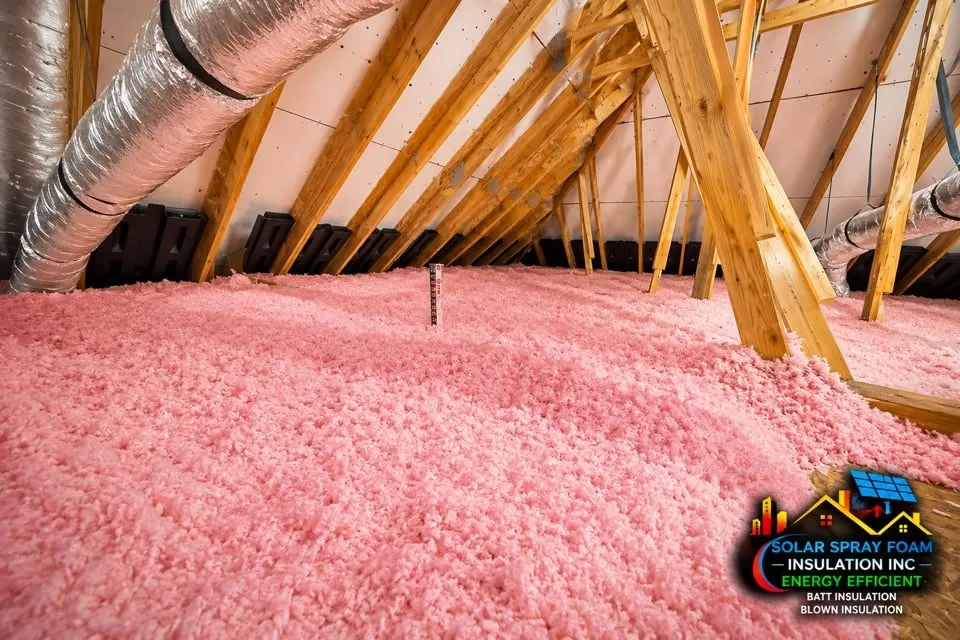
The classic application. Loose-fill covers the entire floor evenly, including around obstructions that batts have to be cut around, and depth gauges let the finished level be checked anywhere in the space.
Material type
Loose-fill blown to a measured depth: the fastest way to bring an attic up to a proper R-value.
What it is
Blown-in, or loose-fill, insulation is fed through a hose and blown into place, so it settles around trusses, wiring, top plates and every irregular corner of an attic floor without leaving the gaps that cut batts leave at their edges.
For an attic that has never been topped up, or one where the original material has compressed over decades, this is normally the fastest and most cost-effective way to reach a modern R-value across the whole floor.
The classic application. Loose-fill covers the entire floor evenly, including around obstructions that batts have to be cut around, and depth gauges let the finished level be checked anywhere in the space.
If what is up there is dry, clean and simply too thin, blown-in can often go straight over it to bring the total depth up rather than starting over.
In finished walls, loose-fill can be dense-packed through small access holes, which insulates without opening up the drywall.
Process
The same order every time, so you know what is happening in your house and when.
We check the current depth, the condition of what is there, the ventilation baffles and whether anything needs to be removed first.
Top plates, penetrations and access hatches are addressed first. Blowing insulation over open air leaks wastes most of the benefit.
Baffles keep the soffit vents clear, and heat-producing fixtures are kept properly clear of the material.
The material is blown in even passes and levelled to the target depth, with gauges left in place so the result can be verified.
Hoses come out through protected routes, the living space is vacuumed, and the attic access is left sealed and tidy.
Benefits
Where it goes
FAQ
It depends on the material and the R-value you are targeting for a northern Illinois attic. We set depth gauges before we start and blow to the depth that reaches the target, so the finished level can be checked anywhere in the attic.
Often yes, if the existing material is dry, clean and not compacted or contaminated. If it is wet, mouldy or has been disturbed by pests, it comes out first.
Blown-in on the attic floor is the usual choice when the attic stays vented and is only used for storage. Spray foam at the roof line makes sense when the attic contains ductwork or living space that needs to be inside the sealed envelope.
Other services
Where we work
We install across Kane County and the towns around it. Solar Spray Foam Insulation Inc. is based in Elgin.
Send us the details of the space and we will come back with a written price. Free estimates, and we typically reply within about ten minutes.