Hot attics and roof decks
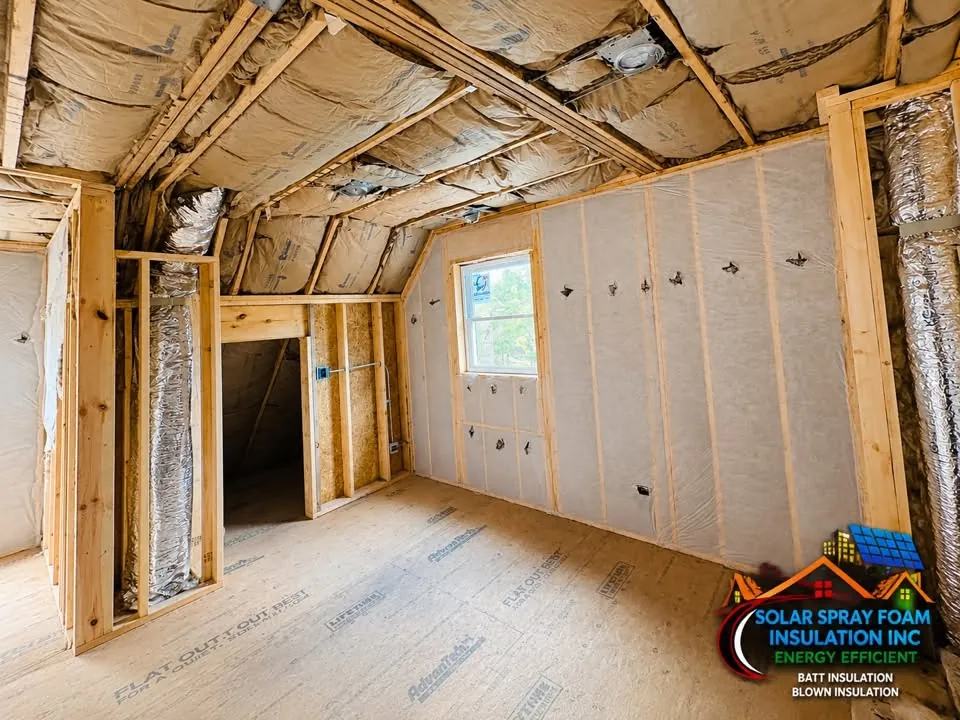
A radiant barrier under the rafters cuts the amount of summer heat radiated down onto the attic floor and into the ductwork running through it.
Material type
Radiant barriers that turn back the heat a roof radiates instead of only slowing it down.
What it is
Reflective and foil insulation works on a different principle from the other three materials. Rather than slowing conducted heat, its bright surface reflects radiant heat, the heat a hot roof deck radiates down into the attic below it on a summer afternoon.
That only works if the foil faces an air gap. Foil pressed flat against a solid surface loses almost all of its effect, which is why installation detail matters more with this material than with any other we install.
A radiant barrier under the rafters cuts the amount of summer heat radiated down onto the attic floor and into the ductwork running through it.
Metal roofs and walls radiate heat aggressively in both directions. A reflective layer with a proper air gap makes those buildings far more usable.
Reflective products complement rather than replace bulk insulation. We usually specify them on top of a properly insulated attic floor, not instead of one.
Process
The same order every time, so you know what is happening in your house and when.
We confirm where the radiant heat is coming from and whether an air gap can be maintained. Without the gap, the product cannot do its job.
Runs are planned so the foil faces the gap, ventilation paths stay clear and the material is continuous across the surface.
The barrier is fastened to the framing with the reflective face exposed to the air space, kept taut and free of tears.
Seams and edges are lapped and sealed so the barrier is continuous, and soffit and ridge ventilation is left unobstructed.
We check the whole run for gaps and compression, then clear the offcuts and fasteners from the space.
Benefits
Where it goes
FAQ
No. It addresses radiant heat, while batts, blown-in and spray foam address conducted heat. In practice we install it alongside a properly insulated attic floor or roof line, not as a substitute for one.
A reflective surface only turns back radiant heat when it faces an open air space. Pressed flat against a solid surface it conducts heat straight through and loses nearly all of its benefit.
It earns its place mainly in summer, in hot attics, garages and metal buildings, and especially where ductwork runs through the attic. For winter heat loss, bulk insulation and air sealing do the heavy lifting.
Other services
Where we work
We install across Kane County and the towns around it. Solar Spray Foam Insulation Inc. is based in Elgin.
Send us the details of the space and we will come back with a written price. Free estimates, and we typically reply within about ten minutes.